Roof shingles repair is one of those jobs that Calgary homeowners tend to either address too late or misdiagnose entirely. A few cracked shingles after a hailstorm look manageable from the ground. Missing tabs after a Chinook wind event seem like a straightforward replacement. What those surface-level observations often miss is what has already happened underneath: water that tracked past a compromised shingle and sat against the deck through two freeze cycles, or granule loss that has been accelerating for two seasons and is only now becoming visible from the street.
Understanding what each shingle failure mode actually means, what caused it, and what the appropriate repair scope looks like is the difference between a $400 fix that holds for years and a $400 fix that buys six months before a larger problem surfaces.
At Lumina Roofing & Exteriors, we inspect enough Calgary roofs after storm events and through seasonal evaluations to know that the shingle is rarely the whole story, and that the homeowners who understand what they are looking at make better decisions before they call anyone.
What Shingle Damage Actually Indicates
A damaged shingle is a symptom, not always the root problem itself. In some cases, particularly after a discrete hail event, the shingle damage is the event: impact that fractured the surface, displaced granules, and compromised the waterproofing integrity of the material at the impact point.
In other cases, a shingle that is cracking, curling, or losing granules is showing the effects of an underlying condition, inadequate attic ventilation driving elevated deck temperatures, ice dam activity backing moisture under the lower courses, or simply a material that has reached the end of its serviceable life.
Roof shingles repair that addresses only the visible shingle without identifying what produced the damage creates a temporary fix over a continuing condition. The new shingle goes down, the underlying condition keeps running, and the next inspection finds the same problem in the same area or adjacent to it.
Calgary’s climate accelerates shingle deterioration through mechanisms that do not apply in milder markets. Freeze-thaw cycles that repeat dozens of times between October and April stress the adhesive strips on shingle tabs, the sealant at flashing transitions, and the granule bond at impact-damaged surface points in ways that a single freeze season does not.
Chinook temperature swings of 25 degrees or more within hours create thermal expansion and contraction forces that test every fastener point and every sealed joint repeatedly through the winter. UV exposure at Calgary’s elevation during summer months drives granule degradation faster than manufacturers’ warranty assumptions developed in lower-elevation test environments often reflect.
Missing Shingles: Causes, Risks, and the Right Repair Approach
Missing shingles are the most immediately visible shingle failure mode and the one that generates the most urgent calls for roof shingles repair. A shingle that has blown off the roof has removed the waterproofing layer at that location entirely, leaving the underlayment and potentially the deck exposed to whatever weather arrives next. In Calgary’s variable climate, that exposure window can include rain, hail, and freezing temperatures within a short timeframe.
Wind uplift is the most common cause of missing shingles on Calgary homes, and it reflects one of two root conditions. Either the shingle’s adhesive strip never fully sealed after installation, which can happen when shingles are installed in cold conditions without adequate time for the strip to thermally activate, or the shingle reached a point in its aging cycle where the adhesive strip hardened and lost its grip.
A third scenario, less common but worth noting, is that the shingles were installed with fasteners driven outside the nailing zone, which reduces the holding strength of each fastener against wind uplift significantly.
The repair for a missing shingle is straightforward in mechanical terms: a new shingle of matching profile and color is slid into position, fastened in the correct nailing zone, and the adhesive strips on the surrounding shingles are confirmed to be sealed.
Curling and Cupping Shingles: Reading What the Roof Is Telling You
Curling shingles present in two distinct patterns that point to different underlying causes. Cupping occurs when the edges of a shingle turn upward, creating a concave profile across the tab. Clawing occurs when the middle of the shingle lifts while the edges stay flat, creating a convex profile. Both patterns compromise wind uplift resistance and can allow water to get under the shingle edge during rain events, but they typically reflect different drivers.
Cupping most often results from moisture differential between the upper and lower layers of the shingle, where the top surface dries faster than the bottom layer absorbs moisture from below. In Calgary, this is frequently a ventilation-related symptom: an attic that runs too warm in winter creates a humidity gradient that accelerates the dimensional change in the shingle substrate.
Repairing cupped shingles without addressing the attic ventilation condition that is driving the pattern produces a roof shingles repair that will face the same problem on the replacement shingles within a few seasons.
Clawing typically reflects an aging shingle that has passed its thermal activation window and begun to stiffen and deform as the asphalt substrate loses flexibility. It is a material-age indicator more than a system condition indicator, and its presence across a significant portion of the roof surface is one of the signals that shifts the conversation from repair to replacement.
A roof where clawing is concentrated in a few isolated areas can be managed with targeted roof shingles repair. A roof where clawing is widespread is showing its age across the full field.
Cracked Shingles and Granule Loss: When Surface Damage Goes Deeper
Cracked shingles on a Calgary roof are most commonly the result of one of three causes: physical impact from hail or falling debris, thermal stress from extreme temperature cycling, or simple age-related brittleness in a shingle that has passed its serviceable lifespan.
Distinguishing between these causes matters for repair scope because impact-related cracking from a hail event may affect far more shingles than are visibly cracked from the ground, while age-related cracking is typically distributed more uniformly across the roof surface.
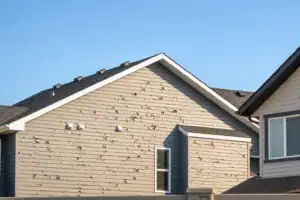
Hail-related cracking on asphalt shingles in Calgary can range from hairline fractures that are only visible during a close physical inspection to complete penetrations through the shingle body that expose the substrate immediately below.
The fractures that fall between those extremes, cracks that have not yet penetrated fully but have compromised the waterproofing integrity of the shingle at the impact point, are the ones that most homeowners miss in a ground-level assessment and that most insurance adjusters evaluate on a physical inspection of the roof surface. Professional roof shingles repair after a hail event requires getting on the roof and assessing each affected section at close range, not estimating damage from the driveway.
Granule loss is one of the most misread shingle condition indicators on Calgary roofs. Finding granules in the gutters after a hailstorm is expected and does not automatically indicate that the shingles are failing. Finding a consistent and heavy flow of granules in the gutters through a dry summer period, or finding shingle areas where the mat beneath the granule layer is exposed across patches rather than at isolated points, is a different matter.

Flashing Failures Misread as Shingle Problems
A significant share of the roof shingles repair calls that turn out to be something other than a shingle problem originate at the flashing, the formed metal components at every transition point on the roof: chimneys, skylights, plumbing stacks, wall intersections, and valleys.
Flashing failures present as water intrusion that appears to be coming from a shingle area, and the diagnostic error of replacing the adjacent shingles without inspecting the flashing is common enough that it is worth addressing directly.
Step flashing along a wall intersection, counter flashing at a chimney, and valley flashing at the intersection of two roof slopes all rely on mechanical forming, correct lapping, and in some cases sealant at specific contact points to keep water from tracking behind the metal and into the roof assembly.
When sealant at a chimney crown dries and cracks through a Calgary winter, or when a step flashing lifts slightly at its upper edge from thermal cycling, the water intrusion that follows appears to originate from the shingle surface nearby because that is where the ceiling stain shows up inside the home.
At Lumina Roofing & Exteriors, our roof shingles repair assessments always include an inspection of the flashing at every transition point on the roof, because that is consistently where the actual source of water intrusion diverges from where the evidence appears inside the home. Whether you are managing a repair on an existing roof or planning roofing work on a new build, our new construction roofing services reflect the same attention to detail at every layer of the assembly.
Repair vs. Replacement: Reading the Threshold Correctly
Roof shingles repair is the right answer when the damage is genuinely isolated, the surrounding field is in sound condition with serviceable granule coverage and intact adhesive strips, the deck beneath the affected area shows no evidence of moisture compromise, and the material has meaningful remaining service life based on its age and condition.
When those conditions are not all true simultaneously, the repair conversation becomes a replacement conversation, and the earlier that shift happens the less additional damage accumulates in the interim.
The threshold that most Calgary roofing professionals use for shifting from repair to replacement is a combination of age, damage scope, and remaining field condition. A roof that is 18 to 22 years old with architectural shingles showing widespread granule loss and cupping across more than 30 percent of its surface area is not a roof shingles repair candidate in a meaningful sense.
A targeted repair on a 10-year-old roof with isolated impact damage from a specific hail event and sound surrounding material is a repair candidate with a high probability of performing well for the remaining service life of the system.
The cost arithmetic matters here as well. Roof shingles repair on a well-defined area of a sound roof is cost-effective because it extends the life of a system that has significant value remaining. The same repair cost applied to a roof that needs replacement within two or three seasons regardless of what is done today is a deferred expense rather than an investment. Identifying which situation you are in before authorizing repair scope is the evaluation that makes the decision financially sensible. If replacement is the better call, start with this guide to asphalt shingles in Calgary to compare your options.
What a Professional Roof Shingles Repair Inspection Covers
A thorough pre-repair inspection begins at the ground with a visual assessment of the full roof surface to identify visible damage patterns, areas of granule loss, lifted or missing shingles, and ridge and hip cap condition. That ground assessment establishes a preliminary damage map before anyone gets on the roof.
From the roof surface, each flagged area is inspected at close range for shingle integrity, fastener condition, adhesive strip function, and any evidence of water tracking at the underlayment level.
The attic inspection is a component that most homeowners do not anticipate as part of a shingles repair assessment, but it is consistently informative. Staining on the underside of the deck at the repair area, insulation that shows moisture compression or discolouration, and any visible daylight at penetration points all provide diagnostic information about whether the shingle damage has already allowed water past the first line of defence.
Documentation of the inspection findings, including photographs of each damage area with its location on the roof noted, gives the homeowner a reference for what was found, what was repaired, and what the surrounding field condition looked like at the time of the repair. That documentation has value if an insurance claim becomes relevant, if the repair is later evaluated by a different contractor, or if the homeowner sells the property and needs to provide evidence of maintenance history.
Protecting What You Have
A well-timed roof shingles repair on a Calgary home extends the life of a roof system that still has meaningful value remaining. The shingles that are repaired correctly today are the ones that do not become the entry point for moisture that compromises the deck this winter. Getting the diagnosis right, understanding what caused the damage rather than just that it happened, and applying the right scope of work is what makes that investment hold.
If you want an honest assessment of the shingle condition on your Calgary home and a clear recommendation on whether repair or replacement is the right path forward, contact Lumina Roofing & Exteriors to schedule a professional inspection before the next weather event makes the decision more expensive than it needed to be.