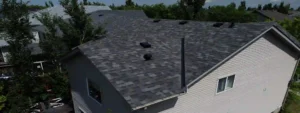
Hail damage to vinyl siding gets missed more consistently than almost any other storm-related exterior problem on Calgary homes, and the reason is simple: everyone looks up first. The roof takes the most visible beating in a hailstorm, and by the time a homeowner has assessed the shingles, noted the dented gutters, and called their insurance company, the siding has received a fraction of the attention it deserves.
The hail that traveled at high speed to strike the roof of your house also struck every other surface of your house at the same high speed. Unlike roofing materials that have a granule layer and/or multi-ply construction to help absorb impact, vinyl siding is a thermoplastic material that responds to impact at different temperatures.
Calgary produces some of the most energetic hail events in Canada, and homes in this city absorb that energy across every surface that faces the sky and the wind. At Lumina Roofing & Exteriors, the exterior assessment after a storm covers the full property envelope, because a roof that took a meaningful hit almost never sustained it alone.
How Hail Actually Damages Vinyl Siding
Hail damage to vinyl siding can occur in distinct ways and it is often misunderstood by homeowners. Much of the damage will cause instant and visible marks to the siding while other impacts will appear to do no damage at all.
The term vinyl refers to a thermoplastic. As the temperature changes, the properties of the material change. This material reacts very differently to a sudden impact in hot weather versus cold weather. In warm weather the material is pliable enough to absorb impact that would leave a dent in July can leave a stress fracture in May or September.
Hail season in Calgary typically spans late spring to early fall. It is during this time that most significant hail events occur when temperatures are not hot but rather mild. At these temperatures, moderate temperature vinyl is more prone to cracking from the inside out than it would be in the warm temperatures of summer when a severe storm feels less severe.
The impact force of wind-driven hail hits vertical siding at different angles than it does a horizontal roof surface. As a result of the many variables, including the path of the storm and the wind speed, the impact pattern on a wall section carries directional information that helps determine which storm event caused it during an insurance assessment.
The upper faces of horizontal panels, where material is thinnest and where the overlap creates a slight ledge that catches driven hail, tend to accumulate damage more densely than the lower panel sections.
Reading Your Siding After a Calgary Hailstorm
A more reliable inspection of potential hail damage to vinyl siding is provided by conducting a systematic walk around the entire exterior perimeter of the house. A drive-by inspection of the house on the day after a storm is not very reliable. The marks on vinyl siding caused by a drive-by check that most homeowners do on the day after a storm. The relevant distance for identifying impact marks on vinyl is about sixty centimetres to one metre from the surface, not several metres from the driveway.
Impact marks show as circular or oval shaped surface disruption at the point of contact. Hail impacts can appear as fresh surface damage. The surface will have been compressed or otherwise altered at the point of impact compared to the surrounding panel surface.
For older siding that already shows surface chalking, impact marks appear as zones of increased chalk disruption or slightly altered surface texture. The distribution of these impact marks within a wall section, their spacing and orientation, indicate the angle of fall of the hail and thus enable the insurer to link this damage to the relevant event.
Cracks starting from impact points or radiating from them indicate that the vinyl was brittle enough to fracture with the energy of the impact instead of deforming. These cracks are often very fine and may appear as hairlines that are only visible under very specific angles of incidence of light. Other cracks are wide enough to be felt with a fingertip.
The hairline version is worth noting as this looks perfectly normal on the day of the storm but two winters on can open up to form a large opening through repeated thermal cycling. Panels that have shifted out of alignment, where the lower edge of one panel no longer sits correctly against the course below it, indicate that impact force at the locking lip was sufficient to displace the panel from its engaged position. If panels are loose or missing rather than cracked or dented, the cause may be wind; see these signs of wind damage to siding.
What Calgary’s Climate Does Hail Damage to Vinyl Siding Over Time
The Calgary climate does not give compromised exterior materials a rest period at hail damage to vinyl siding. Every impact point where hail has disrupted the molecular structure of a vinyl panel becomes a stress concentration site in the thermal cycling that follows, and the temperature range Calgary runs through across a calendar year is among the most demanding on the continent for thermoplastic exterior materials.
By October a hairline fracture had contracted sufficiently that by Calgary’s first winter temperatures as low as -25°C ambient are typical. As the panel tries to shorten as far as the mount will allow, that fall weakness becomes a visible open crack by February. By the following summer the surrounding material had begun to chalk and fade at an accelerated rate relative to undamaged sections of the same panel.
Within a predictable sequence of aging the inspector in the second season of the siding on this home can easily determine where hail is impacted by the aging discoloration and fine cracking that continues to develop long after the impacts themselves have weathered away.
Typically UV exposure at Calgary’s elevation exacerbates problems at areas of siding damage. Intact vinyl siding contains UV stabilizers which help to combat degradation. However, at points of siding damage, the surface has been compromised and the siding’s UV stabilizers are less able to protect the siding from chalking, color change and surface has been disrupted, those stabilizers are less effective, and chalking, color shift, and surface embrittlement progress faster than on the surrounding undamaged material. What starts as a pattern of small impact marks becomes, over two or three seasons, a pattern of accelerated aging concentrated exactly where the hail landed.
Hail Damage to Vinyl Siding and Alberta Insurance Claims
Most home insurance policies in Alberta that cover hail damage to roofing also cover hail damage to siding of the same house. The documentation required for siding damage is the same as for a complete roofing claim. Photos of all affected siding before any repair or cleaning must be taken and recorded with each wall elevation systematically rather than only the most obviously damaged sections.
An insurance adjuster reviewing hail damage to vinyl siding would use the same criteria to determine the amount of damage as a professional inspection would, including the concentration of impact marks on a section of wall and how the pattern of damage relates to the path of the storm.
Before a storm, siding that has undergone significant chalking, surface embrittlement or color fade may make claim filing more difficult since the insurer may claim some of the current siding failure or cracking was in progress prior to it.
A professional contractor assessment documenting damage before the adjuster arrives to inspect would be far more valuable if the assessment reported on the material in question in its pre-storm condition(s) and noted the specific storm damage in that material(s).
At Lumina Roofing & Exteriors, exterior storm assessments cover the siding in the same evaluation as the roofing, producing a single property-wide document that gives the insurer a complete picture of what the storm did to the full envelope. Explore our exterior services to understand how we approach full-property storm damage documentation in Calgary.
Repair or Replace: What the Damage Scope Suggests
The repair versus replacement decision after hail damage to vinyl siding turns on three variables that need to be assessed together rather than in isolation: the extent of the damage across the wall sections, the age and overall condition of the existing material, and whether the specific panel profile and color are available in current production.
Targeted panel replacement would be the appropriate scope of work to repair a limited number of damaged panels while the surrounding siding is sound and has not suffered from widespread embrittlement or chalking, and the manufacturer still produces the same profile in a color that will match the weathered existing material adequately.
The last condition fails more often than one would expect. Vinyl siding profiles and color lines are frequently discontinued, and the difference in sheen and color between a brand new panel and a panel that has weathered through five Calgary summers is visible enough to matter aesthetically even when the profile geometry matches exactly.
The full section or full system replacement of the damaged area is the most complete method of repair to address the scope of damage, eliminates the color matching issue entirely and provides the most cost effective solution for repair of older homes often makes better economic sense than targeted repair when the siding was already in the second half of its service life before the storm.
A 15 year old exterior with impact marks in a widespread pattern of damage on 3 or 4 faces of the walls of a property is not a good candidate for individual panel repair. The scope of damage, the age of the material, and the challenge of color matching make a replacement that delivers a consistent result across the full exterior rather than a patchwork of repairs that documents the storm’s path across the home for years afterward. If replacement is on the table, compare the siding materials for Calgary homes that hold up better to hail before you choose.
Hail Damage To Vinyl Siding: Getting the Full Picture Before Any Decision Is Made
Hail damage to vinyl siding does not stand alone from the condition of the roof, soffits, fascia and eavestroughs all affected by the same storm. When conducting a thorough assessment of the exterior of a home after a storm, all of these elements are assessed as part of the total exterior envelope. If your roof was thoroughly inspected but your siding has half the storm damage picture documented be careful.
A professional exterior assessment that covers the full property before any repair work begins, before any insurance submission is filed, and before any contractor proposal is accepted gives Calgary homeowners the most accurate foundation for every decision that follows a significant hail event.
If your property was in the path of a Calgary hailstorm and you want to know what the siding sustained alongside what the roof took, contact Lumina Roofing & Exteriors to schedule a comprehensive exterior assessment. We will document the full scope of what the storm left behind before you commit to any course of action.