How many bundles of roofing shingles are in a square is one of those questions that sounds simple until you are actually standing in front of a supplier trying to figure out how much material your Calgary roof needs. The standard answer is three bundles per square for most architectural and three-tab asphalt shingles.
That figure holds for the majority of residential products on the market, but it comes with enough variables attached that relying on it without understanding the context around it can send a project short on material, over-budget on waste, or both. A roofing square equals 100 square feet of roof surface, and the bundle count per square reflects the coverage area engineered into each bundle at the manufacturer’s specified exposure.
When the product changes, when the exposure changes, or when a heavier premium shingle profile enters the picture, that three-bundle figure shifts. Add Calgary’s specific climate requirements, the waste factor that complex rooflines generate, and the difference between measuring a roof from the ground versus walking it, and the calculation becomes more consequential than the simple answer suggests.
At Lumina Roofing & Exteriors, accurate material estimation is part of every project assessment we carry out, because a number that is even slightly off on a 30-square roof creates a supply problem that stops work or generates unnecessary return trips to the supplier.
The Direct Answer: How Many Bundles of Roofing Shingles Are in a Square
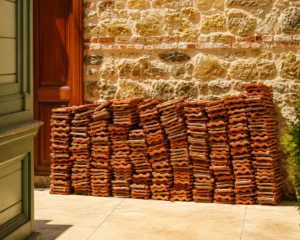
How many bundles of roofing shingles are in a square?Three bundles of roofing shingles cover one square, which equals 100 square feet of roof surface, for standard three-tab and most architectural asphalt shingle products. This is the baseline figure that applies to the majority of residential shingle products available in Calgary’s market and the starting point for any material estimation calculation.
The three-bundle figure is not arbitrary. It reflects the coverage area that manufacturers engineer into each bundle at the product’s standard exposure, which is the amount of shingle visible below the overlapping course above it.
Standard architectural shingles are typically packaged to cover approximately 33.3 square feet per bundle at the manufacturer’s recommended exposure, which multiplied by three bundles produces the 100 square feet that constitutes one roofing square. That packaging calculation is consistent enough across major manufacturers that it holds as a reliable default for standard products.
Where the three-bundle rule breaks down is with heavier premium shingle products, specialty profiles, and certain Class 4 impact-rated lines where the shingle dimensions, weight per unit, or coverage area per piece differ enough from the standard that the manufacturer packages four bundles per square rather than three.
These products are not uncommon in Calgary’s market given the demand for impact-rated shingles in the city’s hail corridor, and assuming three bundles per square on a product that ships four per square produces a material shortfall that becomes apparent mid-installation.
Understanding the Roofing Square and Why It Matters
A roofing square is a unit of measurement, not a physical dimension of any specific roof section. One square equals 100 square feet of roof surface area, and the total square count on a residential roof determines the material order for every component of the installation: shingles, underlayment, ice and water shield, and ridge cap.
Getting the square count right is the foundation of every accurate material estimate, which means the square count calculation is where errors in the estimation process most often originate. The most common misunderstanding about roofing squares is the relationship between a home’s floor plan and its roof surface area. A house with a 1,500 square foot footprint does not have a 15-square roof.
The actual roof surface area depends on the pitch of the roof, the number of slopes, and the presence of features like dormers, valleys, and hip sections that add surface area beyond the simple footprint. A roof at 6/12 pitch on a 1,500 square foot footprint has more surface area than the footprint, and a roof at 12/12 pitch on the same footprint has considerably more.
Pitch multipliers convert horizontal plan area to actual sloped surface area for estimation purposes. A flat roof at 0/12 pitch has a multiplier of 1.0, meaning the surface area equals the plan area. A 4/12 pitch carries a multiplier of approximately 1.054.
A 6/12 pitch multiplies by approximately 1.118. A 9/12 pitch by approximately 1.25, and a 12/12 pitch by approximately 1.414. Applying the correct multiplier to each roof section before summing the total square count is what produces an estimate that reflects the actual surface area rather than the building footprint, so it’s a short explanation of how many bundles of roofing shingles are in a square.
How Shingle Exposure Affects Bundle Count Per Square
Shingle exposure is the dimension of each shingle that remains visible below the overlapping course above it, and it determines how many individual shingles are required to cover a given area. Standard architectural shingles have a nominal exposure of approximately 5 to 5.625 inches depending on the product and manufacturer. That exposure dimension, combined with the shingle width, determines the coverage area per piece and therefore the coverage area per bundle.
When shingles are installed at a non-standard exposure, either because the roof pitch requires an adjusted installation method or because a contractor has deviated from the manufacturer’s specification, the coverage area per bundle changes. Reducing the exposure below the manufacturer’s recommendation requires more shingles per square foot and increases the bundle count needed for a given area.
Increasing the exposure beyond the recommended dimension reduces the number of shingles per square foot but compromises the overlap between courses in ways that affect water shedding performance.
In Calgary’s climate, where proper overlap and sealing between shingle courses is directly relevant to ice dam resistance and wind-driven rain performance during spring storms, installation at the manufacturer’s specified exposure is the correct approach rather than a flexible variable.
Calculating How Many Bundles of Roofing Shingles in a Square Your Calgary Roof Needs
The calculation for how many bundles of roofing shingles are in a square scales directly into a full roof material estimate. Starting with the roof’s total square footage measured along the sloped surface, divide by 100 to get the square count. Multiply the square count by three for standard three-bundle-per-square products, or by four for premium products packaged at four bundles per square.
A straightforward example: a roof with a measured sloped surface area of 2,200 square feet equals 22 squares. At three bundles per square for a standard architectural shingle product, the base material count is 66 bundles. Applying a 10 percent waste factor for a moderately complex roofline with a few valleys and one dormer adds approximately 7 bundles, bringing the total order to 73 bundles.
Ridge cap material is ordered and measured separately from field shingles. Ridge cap products are sold in bundles that cover a specified linear footage of ridge and hip rather than square footage of field. Measuring the total linear feet of ridge and hip on the roof and dividing by the coverage per bundle for the selected ridge cap product produces the separate ridge cap order quantity.
Attempting to cut field shingles into ridge cap pieces as a cost-saving measure, a practice some less thorough installations use, produces a cap layer that is not engineered for the flexibility, wind resistance, or UV exposure of the ridge position.
Waste Factor: The Variable That Calgary Roof Complexity Changes Most
This is also related to the question; how many bundles of roofing shingles are in a square? Waste factor is the additional material percentage added to the base square count to account for cuts at valleys, hips, ridges, rakes, and penetrations that produce unusable offcuts. A simple gabled roof with one ridge and two rakes and no other features generates relatively low waste. A complex residential roofline in one of Calgary’s older established neighbourhoods, with multiple valleys, dormers, skylights, and a hip configuration, generates significantly more.
Standard waste factor allowances range from 10 percent on simple rooflines to 15 percent on moderately complex roofs and up to 20 percent or higher on very complex configurations. Applying a flat 10 percent waste factor to a complex hip roof or a roofline with multiple dormers underestimates the material requirement in ways that become apparent when the crew runs short on a section that required more cuts than the estimate anticipated.
In Calgary specifically, the additional waste generated by ice and water shield installation at valleys, eaves, and all penetration areas adds to the total material order beyond just the shingle waste factor. Ice and water shield is ordered by the square similarly to shingles but is applied more generously at the detail areas than a simple eave coverage calculation would suggest. A thorough material estimate accounts for the ice and water shield quantity separately from the shingle count rather than rolling both into a single square footage figure.

How Many Bundles of Roofing Shingles Are in a Square: Bundle Weight and Its Practical Implications
Standard architectural shingle bundles weigh between 60 and 80 pounds each depending on the product line and the shingle weight per square. Premium Class 4 impact-rated shingles, which use heavier granule coating and modified asphalt substrates to achieve their impact resistance, can run 80 to 100 pounds per bundle or higher on certain products. That weight difference matters for two practical reasons on a Calgary roofing project.
The first is structural: a roof deck that is carrying the existing shingle layer plus the new material during the staging phase of a tear-off and replacement project is briefly supporting considerably more weight than its finished load.
On older Calgary homes with roof framing designed to the standards of their construction era, the combined staging weight of material stored on the roof surface before installation is a consideration that experienced contractors account for by distributing staged bundles across multiple roof sections rather than concentrating them in one area.
At Lumina Roofing & Exteriors, every material estimate we produce accounts for the specific product’s bundle-per-square count, the pitch multiplier for each roof section, the appropriate waste factor for the roofline’s actual complexity, and the separate quantities for ice and water shield, underlayment, drip edge, and ridge cap.
How Many Bundles of Roofing Shingles Are in a Square for Ridge Cap
Ridge cap shingles are a separate product category with their own bundle coverage unit. Most dedicated ridge cap products cover between 20 and 35 linear feet of ridge or hip per bundle depending on the product and the exposure at which it is installed. A roof with 60 linear feet of ridge and 80 linear feet of hip, totalling 140 linear feet of peak coverage, requires 4 to 7 bundles of ridge cap material depending on the specific product’s coverage rate.
Using field shingle bundles to calculate ridge cap coverage is a calculation error because the coverage units are different: field shingles cover square footage while ridge cap covers linear footage. The two cannot be interchanged in the estimate without producing a figure that is either significantly short or overstated depending on which direction the conversion error runs.
Starter course material is a third separate calculation. Starter strips are installed along the eave and rake edges before the first full course of field shingles, and they are sold either as dedicated starter strip products covering a specified linear footage per bundle or as field shingles cut with the tabs removed. A complete material estimate includes a linear footage calculation for the eave and rake perimeter of the roof converted to the appropriate bundle count for the selected starter product.
When an Estimate Needs More Than a Bundle Count
Knowing how many bundles of roofing shingles are in a square gives a homeowner the foundation for verifying a material quantity in a contractor’s quote or for estimating a basic supply order. It is a useful reference number, and for a straightforward roof with a known pitch and a simple configuration, it produces a reasonably accurate planning figure.
Where the estimate needs professional input is at the level of deck condition, underlayment specification, flashing scope, ventilation assessment, and the project variables that a material count cannot capture from a measurement exercise alone. A Calgary roof that calculates to 22 squares of material may also need three sheets of deck replacement, upgraded soffit venting, reflashing at the chimney, and ice and water shield applied further up the slope than a standard eave coverage formula suggests.
If you are at the point where the material estimate is part of a real project decision rather than a general planning exercise, contact Lumina Roofing & Exteriors to schedule a professional evaluation. We will give you an accurate picture of the full material and labour scope before you commit to a contractor or a product.