The comparison between 3 tab roof shingles vs architectural shingles comes up in almost every asphalt roofing conversation in Calgary, and the honest answer has shifted significantly over the past decade. Ten years ago the decision was a genuine trade-off between cost and performance. Today, with the price gap between the two product tiers having narrowed considerably while the performance gap has stayed largely intact, the comparison resolves more clearly than it once did for most Calgary primary residences.
That does not mean three-tab shingles have no place in this market. It means the circumstances where they make sense have become more specific, and understanding those circumstances is more useful than a categorical dismissal of either option. Calgary’s climate adds a layer to this comparison that national product guides rarely address: how each shingle type responds to freeze-thaw cycling, Chinook temperature swings, hail impact, and the wind loading that Chinook events produce changes the practical value of the performance gap between these two products in ways that matter more here than in milder markets.
At Lumina Roofing & Exteriors, material selection conversations for asphalt roofing almost always include this comparison, and where the recommendation lands depends on the property, the structure, and the ownership plan rather than a single answer that fits every Calgary home.
What Separates These Two Products at the Construction Level
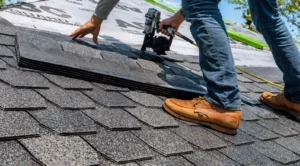
Between 3 tab roof shingles vs architectural shingles, the first are a single-layer asphalt product. Each shingle unit is a flat rectangle with two cutouts that divide the lower section into three uniform tabs, creating the appearance of separate shingle units when installed in overlapping courses. The flat, single-layer construction is the defining characteristic of the product, and it is what drives most of the performance differences between three-tab and architectural alternatives.
Architectural shingles, also called dimensional or laminate shingles, bond two layers of asphalt material together during manufacturing. The upper layer is shaped to create a dimensional profile with varying tab sizes and shadow lines that give the installed roof a more textured, less uniform appearance than three-tab produces. The bonded two-layer construction adds mass, increases the thickness of the product at its lower edge, and creates a heavier adhesive strip contact area between courses when the shingles are installed.
That construction difference is not a cosmetic distinction. It is the source of the wind resistance advantage, the weight difference, the adhesive strip performance gap, and the lifespan differential that separate these two product categories in Calgary’s conditions. Understanding how asphalt shingles are made helps homeowners evaluate the performance claims in each category without relying on marketing language to make the comparison for them.
Wind Resistance: Where Calgary’s Chinook Conditions Matter Most
The wind resistance difference between 3 tab roof shingles vs architectural shingles is the performance gap that Calgary’s climate tests most directly. Standard three-tab shingles carry manufacturer wind ratings that typically run to 90 to 100 kilometres per hour for their adhesive strip to maintain tab contact under sustained wind loading. Architectural shingles from major manufacturers carry ratings of 110 to 130 kilometres per hour on standard product lines, with enhanced wind resistance versions reaching higher.
Calgary’s Chinook events produce sustained winds that regularly reach and exceed the lower end of the three-tab wind rating range. A Chinook that brings a temperature increase of 20 degrees in a few hours typically arrives with wind that tests adhesive strip performance on aging shingles. Three-tab shingles that have been through several Calgary winters and whose adhesive strips have begun to stiffen through thermal cycling are most vulnerable to tab lifting during those events.
Architectural shingles resist that sequence better because their heavier adhesive strip has more contact area with the course below it, their laminated construction adds stiffness to the tab profile that resists the initial lift, and their wind rating provides a larger buffer above the wind speeds Calgary’s Chinook events regularly produce. The wind resistance advantage over three-tab is one of the clearest performance arguments for the upgrade in a market where sustained Chinook winds are a seasonal certainty rather than an occasional event.
3 Tab Roof Shingles Vs Architectural Shingles: Lifespan in Calgary’s Specific Climate Conditions
How long each product realistically lasts on a Calgary home reflects the construction differences more than the warranty terms on the packaging. In the case of 3 tab roof shingles vs architectural shingles, three-tab shingles in Calgary’s climate typically deliver 15 to 20 years before material condition warrants replacement.
Their single-layer construction has less thermal mass to moderate the temperature cycling stresses that Calgary’s freeze-thaw seasons and Chinook events impose, their adhesive strips are lighter and lose bonding strength faster, and their flat profile shows granule loss and surface ageing more uniformly and earlier than the dimensional surface of architectural products.
Architectural shingles on a Calgary home with adequate attic ventilation and no significant hail damage history realistically deliver 22 to 28 years. Class 4 impact-rated architectural products extend that range toward 25 to 30 years. The difference between those lifespan estimates and the three-tab range is real enough on a 2,000 square foot roof that it changes the lifetime cost comparison between the two products significantly when replacement cycles and their associated labour and disposal costs are factored into the total.
On a 50-year ownership horizon, a Calgary home with three-tab shingles may require replacement two to three times. The same home with architectural shingles requires replacement once or twice over the same period. Each replacement carries material cost, labour cost, tear-off and disposal cost, and the disruption of a full roofing project. The product that costs more per bundle at the outset may cost considerably less over the full ownership period, and that arithmetic is worth doing before the lower upfront number becomes the deciding factor in the specification decision.
Side-by-Side Comparison: 3-Tab vs. Architectural Shingles for Calgary Homes
| Attribute | Three-Tab Shingles | Architectural Shingles |
| Construction | Single layer, flat profile | Laminated two-layer, dimensional |
| Installed cost premium | Lower baseline | 10 to 20% above three-tab |
| Wind rating | 90 to 100 km/h typical | 110 to 130 km/h typical |
| Realistic lifespan Calgary | 15 to 20 years | 22 to 28 years |
| Hail resistance | Standard | Improved; Class 4 available |
| Granule loss rate | Faster surface ageing | Slower, heavier granule coating |
| Aesthetic profile | Flat, uniform appearance | Dimensional, shadow line depth |
| Manufacturer warranty | 20 to 25 years typical | 30 to 50 years typical |
| Freeze-thaw performance | More susceptible with age | Better thermal mass retention |
| Recommended application | Secondary structures | Primary residences |
Hail Performance: An Honest Assessment for Calgary’s Market
The comparison between 3 tab roof shingles vs architectural shingles in Calgary’s hail corridor requires an honest acknowledgment that neither standard product is engineered specifically for hail resistance. Both standard three-tab and standard architectural shingles are designed to manage the water, wind, and UV exposure of normal weathering conditions. Neither is specifically rated for hail impact resistance without the Class 4 designation from UL 2218 testing.
The practical difference between the two under hail impact is a consequence of their construction rather than a specific design intent. These, with their laminated two-layer substrate, have more material to absorb impact before fracturing than single-layer three-tab products. A hail stone that fractures a three-tab shingle may leave a surface bruise and granule displacement on an architectural shingle of comparable age.
That difference is real but should not be mistaken for impact resistance engineering. Standard architectural shingles are better than three-tab under hail impact. They are not hail-resistant products.
Class 4 impact-rated shingles are the product that actually addresses Calgary’s hail exposure with engineering intent rather than as a side effect of laminated construction. For Calgary primary residences in areas with documented hail exposure, the 3 tab roof shingles vs architectural shingles comparison should ideally include Class 4 architectural as the practical specification recommendation rather than positioning standard architectural as the upper end of the comparison.
Standard shingles outperform three-tab under hail. Class 4 architectural shingles outperform standard architectural in the same conditions, and in Calgary’s market that performance tier is worth specifying.
3 Tab Roof Shingles Vs Architectural Shingles Costs: The Gap That Has Narrowed
The upfront cost difference between 3 tab roof shingles vs architectural shingles has narrowed considerably over the past decade as architectural products became the dominant residential specification and their manufacturing volumes increased relative to three-tab. The current premium for architectural shingles over three-tab on a Calgary residential roof runs approximately 10 to 20 percent on the material cost alone, which on a 2,000 square foot roof translates to a difference of roughly $800 to $1,500 in material cost before labour.
Labour cost is comparable between the two products for most standard installations. The installation method is similar enough that crew time per square is not meaningfully different between three-tab and standard architectural shingles on a straightforward roofline. The total installed cost premium for architectural over three-tab on a typical Calgary home runs $1,000 to $2,000, a figure that the lifespan difference between the two products recaptures within the first replacement cycle comparison.
The cost argument for three-tab shingles, which was more compelling when the material premium was larger, now applies most clearly to secondary structures where the ownership horizon is shorter, the aesthetic outcome matters less, and the performance gap is an acceptable trade-off given the structure’s value. On a primary Calgary residence, the $1,000 to $2,000 premium for architectural shingles over three-tab is difficult to justify skipping given the lifespan, wind resistance, and aesthetic advantages that come with it.
Aesthetic Differences and Their Long-Term Relevance
The visual difference between 3 tab roof shingles vs architectural shingles is immediately apparent on installed roofs of any pitch above 4/12, and it becomes more pronounced on steeper pitches where the dimensional profile of architectural shingles creates visible shadow lines that give the roof a depth and texture that flat three-tab profiles cannot replicate. For Calgary homes on steeper residential pitches, which are common in established inner-city neighbourhoods and in newer construction that favours higher-pitch designs, the aesthetic distinction is meaningful enough to affect property appearance and curb appeal in ways that prospective buyers notice.
Three-tab shingles age visually in a pattern that the flat profile makes more visible than on architectural products. As granules wash off uniformly from the flat surface, the shingle’s color fades and the mat below begins to show through in a pattern that is visible from the street at a relatively early stage of the product’s aging cycle. Architectural shingles age with more visual complexity because the dimensional surface creates shadows that partially mask granule loss, and the varied tab sizes and shadow lines maintain a more robust visual profile at the same age.
That aesthetic longevity is relevant beyond cosmetics. A roof that looks aged, faded, or worn from the street affects the perceived condition of the property for anyone evaluating it, whether for purchase, insurance renewal, or neighbourhood standards compliance. On a Calgary home where property presentation matters, the visual aging rate of three-tab shingles is an additional argument for architectural products that sits alongside the performance comparisons.
At Lumina Roofing & Exteriors, the 3 tab roof shingles vs architectural shingles conversation always resolves at the property level rather than as a category preference. Secondary structures on the same property may be appropriate candidates for three-tab specification while the primary residence receives architectural or Class 4 architectural shingles. Explore our residential roofing services to understand how we approach material selection as part of a complete evaluation rather than a product recommendation made without seeing the home.

When Three-Tab Shingles Still Make Sense in Calgary
Three-tab shingles retain a legitimate place in Calgary’s roofing market under specific circumstances. Detached garages that are not climate-controlled and whose roofline is not prominent from the street are the most common application where three-tab specification makes practical sense. The cost saving relative to the structure’s value is more meaningful than on a primary residence, the performance gap is an acceptable trade-off at that scale, and the lifespan of 15 to 20 years is adequate for a secondary structure.
Garden sheds, small agricultural buildings, and outbuildings where the roofing function is purely protective rather than aesthetic or long-term investment driven are also appropriate three-tab applications. The material does its job in those contexts, and specifying architectural shingles on a small garden shed is a cost allocation that most homeowners would not find reasonable on reflection.
The scenario where three-tab shingles are not the appropriate specification is a primary Calgary residence where the homeowner expects the roof to deliver its rated performance over 20 or more years, where Chinook winds will test adhesive strip integrity every winter, where hail events will eventually occur, and where the visual condition of the roof affects the property’s presentation. In that context, the modest cost premium for architectural shingles is not a discretionary upgrade. It is the baseline specification that the home’s conditions require.
Making the Right Call Before Your Replacement Project
The 3 tab roof shingles vs architectural shingles decision is one that most Calgary homeowners resolve clearly once the performance differences are set against the actual cost gap and the specific conditions of their property. For primary residences, architectural shingles at minimum, and Class 4 architectural shingles for properties with documented hail exposure, represent the specification that delivers the performance the investment warrants. For secondary structures with shorter planning horizons and less demanding aesthetic requirements, three-tab remains a legitimate and cost-appropriate choice.
If you are planning an asphalt shingle roofing project in Calgary and want an honest assessment of which product specification makes the most sense for your specific property before you request contractor quotes, contact Lumina Roofing & Exteriors and we will walk through the material options that fit your home, your budget, and the ownership plan that shapes what long-term value means for your situation.