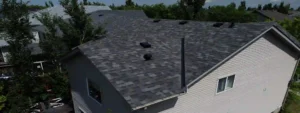
Wind damage to roof in Calgary rarely looks the way homeowners picture it. The scenario most people imagine, a visible chunk of missing shingles after a storm, is actually the version that gets addressed quickly because nobody misses it from the driveway.
The damage could have occurred previously and look fine from ground level. The roof’s adhesive strips may have failed beneath the tab edges. The ridge cap may have shifted two centimetres off its sealed position, or the counter flashing at the chimney is holding on through friction rather than through the bond that sealed it.
At Lumina Roofing & Exteriors, we inspect Calgary roofs after wind events every active season, and the calls that involve the most damage are almost never the ones placed the morning after the storm. They are the ones placed three weeks later, after the rain got in.
What Wind Damage to Roof Actually Covers
While missing shingles are the most obvious sign of wind damage to roof, the full extent of damage can vary greatly, and much of it is not visible. This more in depth look at what can happen to a roof in strong winds helps a Calgary homeowner understand the extent of the ability to assess their own roof after a wind event with enough accuracy to know whether to call someone that week or that afternoon.
Tab lifting is the failure type that precedes most of the visible damage found on Calgary roofs after Chinook events. Wind attacks the lower edge of a shingle tab, wherever the adhesive strip for that shingle has weakened with age, with cold weather keeping the thermal re-sealing of shingle shoulders from happening in the proper time in the seasons, or from having a previous wind cycle that broke the initial bond without completing the separation.
Complete shingle separation follows lifted tabs that passed a threshold the fasteners could not hold. The wind uplift forces on a shingle that is no longer adhesively bonded to the course below eventually overcome fastener resistance, and the piece comes off. That exposed underlayment beneath it is now bearing the full waterproofing load for that section of roof, and in Calgary’s climate the next precipitation event rarely waits long enough for the exposure to feel theoretical.
A ridge cap coming loose at one end due to wind pressure, a valley liner edge shifting sideways due to debris impact during a storm, and a chimney counter flashing becoming dislodged from its mortar joint due to suction on the leeward side of the stack, all of those create water entry pathways that the surrounding shingles cannot compensate for regardless of their condition.
How Calgary’s Chinook Pattern Creates Roof Stress That Other Wind Types Do Not
In Calgary, wind damage to roofs occurs in a unique climate context that is very different from the vast majority of other cities and towns in Canada. And while the Wind events can occur at any time of year, damage to roofs from Chinook events is a particular test of a roofing assembly stronger than wind events. They are a specific combination of characteristics that tests roofing assemblies in ways that steady prevailing winds or seasonal storm systems do not replicate.
The onset speed of the Chinook wind is of primary importance. Within a few hours, Calgary can go from calm winds to sustained 80 to 90 km/h winds with a few hours, and the gusts that accompany the sustained wind regularly reach 110 to 120 kilometres per hour on south and southwest-facing properties where the topographic funnelling effect through the foothills corridor concentrates the flow.
A roof left to sit in below zero temperatures can have its roofing material (asphalt in the shingle substrate and adhesive strips) hardened. When the load is applied and loses its pliability, it is suddenly subjected without the benefit of the gradual warming that would allow the material to regain some flexibility before the peak force arrives.
The pressure dynamics of Chinook flow over a residential roofline create a failure mechanism that surprises homeowners who assume the windward slope took the most damage. Wind speeding over the peak of a roof creates a low-pressure area on the reverse or leeward side of the roof. This low-pressure area pulls material up from beneath the roof while wind is pushing against the top of the roofing material on the windward side of the roof.
The effective wind resistance of aging Calgary shingles through a late October Chinook is lower than the product specification suggests, and understanding that gap is part of reading the damage patterns correctly after the event. For more on the freeze-thaw side of the problem, see how Chinooks affect your roof over a full winter.
Reading Your Roof After a Wind Event: What to Look For From the Ground
Assessing wind damage from the ground is an acceptable initial approach to identify obvious damage and to determine whether an assessment from above is required. From the ground, using binoculars or the zoom function of a smart phone from a safe distance and at an angle to the roof surface, makes the following indicators visible enough to assess before any professional inspection is scheduled.
Missing shingles are the most direct indicator and the one that drives the fastest response. Roof areas where grey or black underlayment shows through a gap between shingles must be addressed prior to the next rain event. Given the natural fall weather pattern of events in Calgary, this could be only a few days away. Be sure to note the location of missing shingles in relation to the roof’s orientation.
Lifted or curled tab edges are evident on lower courses of the shingle field even from ground level on a clear day. Whilst the shingle may not have fully separated, adhesive strip failure has occurred. Lifted tab edges appear to be flat against the shingle above when viewed straight on. However, when viewed from an angle, the edges reveal the gap between the tab edge and the surface below it. Those areas need professional securing before the next wind cycle completes the displacement.
Ridge cap condition along the full length of the roof peak is worth examining systematically. A ridge cap that has shifted laterally, lifted at one end, or shows a visible gap between the cap and the peak of the shingle field below it is damaged regardless of how the field shingles on either side appear. The ridge is the most exposed point on the entire roof and the one where wind damage most consistently shows up first.
What a Professional Wind Damage Inspection Actually Covers
While a ground-level inspection can identify many areas of wind damage to roof, a close-range professional inspection is required to establish the full extent of the damage. A thorough roof inspection begins with a ground survey to establish a preliminary damage map. Each area identified on the map can then be inspected in close range and with hand pressure to shingles, lift flashing edges, and probe sealant points that a visual review from below cannot reach.
On the roof surface, each flagged area is assessed for fastener integrity at the shingle, adhesive strip condition on the courses surrounding the visible damage, and any evidence of shingle movement that left the fastener in place but broke the bond. A shingle that lifted during the wind event and partially re-seated when the wind dropped may test as secure under hand pressure from above but have a broken adhesive perimeter that the next Chinook will open completely.
The flashing assessment at every transition point on the roof is a non-negotiable part of a wind damage inspection in Calgary. Chinook pressure differentials are particularly effective at disturbing components that rely on gravity and sealant rather than mechanical engagement to stay in position: counter flashing at chimney tops, valley liner edges that sit in a channel rather than being fastened continuously, and step flashing at wall intersections that was relying on the weight of the shingles above it to stay seated. Wind and hail often arrive in the same storm, so a good inspection checks for both. These are the signs of hail damage to a roof worth knowing.
Navigating the Insurance Process for Wind Damage in Alberta
Calgary homeowners whose roof sustains wind damage that exceeds their insurance deductible are managing a claim process that goes most smoothly when the documentation starts immediately after the event and before any repair work begins. Alberta home insurance policies generally cover sudden and accidental wind damage to roofing systems and the interior damage from water intrusion that follows it. The documentation that supports that coverage is worth building carefully.
Photographing the damage before any cleanup or temporary protection work begins is the foundation of a clean claim submission. Time-stamped photographs taken from the ground and, where safe roof access is available, from the roof surface itself give the insurer visual evidence correlated to the specific event. Weather service data confirming the wind speeds recorded in the Calgary area during the specific event adds objective context to the visual evidence, and keeping that data alongside the photographs creates a claim file that is easy to follow and difficult to dispute on chronological grounds.
The distinction between wind damage and pre-existing deterioration is the most consistent point of contention in Alberta wind damage claims on older roofing systems. An insurer may characterize lifted tabs on a twenty-year-old roof as normal age-related adhesive failure rather than event-specific wind damage, particularly if the shingles show widespread granule loss or cupping that predates the storm.
At Lumina Roofing & Exteriors, post-storm wind damage assessments are part of how we support Calgary homeowners through both the repair decision and the insurance process. A documented contractor assessment in hand before the adjuster arrives creates a reference point that protects the homeowner’s position if the insurer’s scope assessment differs from what the professional inspection found. If the siding was also hit, the process for wind damage to siding insurance claims works a little differently.
Repair vs. Replacement After Wind Damage in Calgary
Whether wind damage to roof warrants targeted repair or full replacement is a property-level question that the damage assessment answers specifically rather than through a general rule. The relevant factors are how much of the total roof area is affected, the age and field condition of the shingles surrounding the damage, and whether the wind event revealed an underlying condition across the broader shingle field that makes the surrounding material as susceptible to the next event as the areas that failed in this one.
Targeted repair makes sense when the damage is genuinely isolated, the surrounding field has intact adhesive strips, adequate granule coverage, and no widespread cupping or clawing, the deck beneath the affected area shows no moisture compromise, and the material has meaningful remaining service life relative to its age and product type.
Replacing thirty shingles on an eight-year-old Class 4 roof with sound surrounding material is a repair project, and treating it as a replacement trigger because some shingles came off would be an overreaction to a contained event.
Full replacement becomes the appropriate recommendation when the wind event has exposed a roofing system that was already close to the end of its effective service life, when the adhesive failure the wind revealed is not limited to the visibly affected area but shows up across a broad section of the field under hand pressure, or when the total damage scope represents a portion of the roof large enough that patchwork repair would leave a structurally inconsistent assembly.
Temporary Protection When the Repair Cannot Be Immediate
When wind damage leaves a section of deck or underlayment exposed to incoming weather before a permanent repair can be scheduled, temporary protection limits the compounding damage that Calgary’s shoulder season conditions can produce in the days between the wind event and the repair appointment.
A heavy-duty polyethylene tarp extended past the eave edge into the gutter and secured with distributed ballast weight provides adequate moisture protection for most residential wind damage scenarios.
The securing method is the detail that determines whether the temporary protection survives the follow-up Chinook that often arrives within days of the initial event. A tarp draped loosely over damaged shingles and held with a few bricks at the corners will not stay in position through a secondary wind event.
Weight needs to be distributed across the tarp surface in a way that prevents the tarp from lifting and channelling air beneath it, which can cause it to act as a sail and pull material off the damaged section rather than protecting it.
Professional emergency tarping services in Calgary are appropriate when the exposed area is large enough that homeowner management of the tarp is not practical, or when the roof configuration makes safe ground-based tarp management impossible. The cost of professional temporary protection is modest relative to the interior damage that an unprotected deck sustains through a single Calgary rain event in October, and it is recoverable as part of the insurance claim for the original wind damage.
Taking the Right Next Step
Wind damage to roof in Calgary exists on a spectrum from minor tab lifting that needs professional securing before the next wind event to significant shingle loss that has already created an active water intrusion problem. Where your specific roof sits on that spectrum requires a close-range inspection by someone who has physically assessed the damage rather than estimated it from the driveway.
If you have been through a significant wind event in Calgary and are not certain what your roof sustained, contact Lumina Roofing & Exteriors to schedule a professional wind damage assessment before the next weather event turns an uncertain situation into a confirmed one.