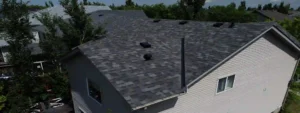
Wind damage roof shingles in Calgary are shaped by patterns that show up after Chinook winds. Signs of damage include tabs that lift and ridge caps that move. There are also hidden problems like broken glue strips that only become visible when it rains.
Chinook winds bring challenges to shingles that regular wind ratings don’t take into account. These challenges include changes in temperature, long periods of wind pushing on the roof and differences in air pressure that push shingles up.
Knowing how these things work helps Calgary homeowners check their roofs carefully after a storm. Lumina Roofing & Exteriors offers inspections that are made for Calgary’s conditions. They look at damage to shingles instead of just using standard tests. This helps homeowners understand what repairs are needed.
How Wind Actually Damages Roof Shingles
Wind damage to roof shingles happens in two ways during strong wind events. The first way is when wind pushes on the side of the roof that faces the wind. This creates a difference in pressure that pushes up on the bottom of each shingle at the edge. The glue strip that holds the shingles together is very important in stopping this push. If the glue strip is broken because of age, cold weather or previous wind events the shingles can lift. This makes the nails on the shingles exposed to wind and rain.
The second way is when wind pulls on the side of the roof that’s away from the wind. The wind moves fast over the top of the roof creating a low-pressure area that pulls the shingles up. This usually causes shingles to be lost on the north or east sides of the roof than on the south side.
Both ways put kinds of pressure on the nails and shingles. This helps in checking the roof after a storm. Also the long Chinook winds in Calgary bring a problem that regular wind tests don’t consider. When wind blows for a time it can make the glue strip weaker over time. This reduces how strong the shingles are making them more likely to fail as the wind keeps going.
Wind Damage Roof Shingles: The Calgary-Specific Context
Calgary’s geographical position at the eastern edge of the Rocky Mountain foothills leads to distinct wind conditions that differ from standard asphalt shingle wind ratings, particularly during Chinook events.
These events can rapidly escalate wind speeds from calm to 70-85 miles per hour within two hours, subjecting roofing materials to near-peak loads too quickly for them to adapt. As a result, shingles may experience damage at load levels below their rated resistance due to the combination of sudden wind force and the cold-stiffened adhesive.
Adhesive strips usually struggle to perform in low temperatures, leading to increased shingle failure during these events.
Chinooks occur primarily in Calgary’s shoulder seasons, where cooler rooftop temperatures further diminish adhesive efficacy, resulting in more severe wind damage. Additionally, south and southwest-facing roof slopes in Calgary endure more cumulative wind exposure, suffering higher damage rates compared to sheltered orientations.
Identifying Wind Damage Roof Shingles From the Ground
The ground-level assessment after a wind event is a legitimate first step and can identify the most urgent damage conditions without requiring anyone to get on a roof that may be compromised. The following indicators are what a post-Chinook ground assessment looks for systematically on a Calgary home.
Missing shingles are a key indicator of roof damage, determining if the situation is urgent. Visible grey underlayment or brown decking means the waterproofing layer is compromised, especially crucial with Calgary’s fast-approaching fall and winter weather conditions.
The location of these missing shingles reveals the type of damage: missing shingles on the leeward slope suggest suction failure, while those on the windward side indicate direct uplift failure.
Curled or lifted edges on lower shingles can also be observed from ground level, showing broken adhesive bonds that risk further damage during subsequent wind or cold events. These gaps should be documented from an angle that highlights the issue rather than from directly below.
The condition of the ridge cap is another critical observation post-wind event. As the most exposed part of the roof, any lateral shifts, gaps, or misalignments in the ridge cap indicate failures necessitating professional intervention, irrespective of the main field shingles’ conditions.
Granule loss, evidenced by deposits in gutters or splash blocks following a wind event, also signifies substantial damage. This loss is particularly problematic in older shingles with weakened granule adhesion, shortening their lifespan after significant wind events. Combining granule loss with mechanical failures helps assess whether the wind event has caused the need for repairs or if it triggers a full roof replacement.
What a Professional Wind Damage Shingle Inspection Covers
Wind damage roof shingles assessment at the professional level goes beyond what ground observation reveals, and the value of that additional access is highest on roofs where the visible damage is limited but the wind event was significant. A professional inspection at close range examines the following conditions that ground assessment cannot reliably evaluate.
The condition of adhesive strips on shingles around visible damage is crucial for assessment. A shingle that looks fine may actually have a broken bond. The only way to see this is by lifting the tab edge.
If the tab lifts freely the bond is weak. That means the shingle could separate again when the wind blows next. Because of this we must change our plan. By patching only a few shingles we need to re‑secure many shingles across the roof.
Fastener conditions reveal whether the adhesive or the fastener failed. When a shingle pulls away at a fastener it shows that the wind is stronger than the fastener can hold. When a shingle tears through the nailing hem it shows that the fastener or the material has weakened. Either way the holding ability is lost.
Flashing along ridge lines and near penetrations must be checked by hand. Wind can lift flashing. Break its seal even if the flashing looks good from far away. It is also important to look inside the attic under the damaged roof. That gives us a view of the problem.
Look for signs such as daylight coming through new moisture stains, on the sheathing or any evidence that water has passed through. These signs tell us how urgent the repairs are and how damage there is. Together, these clues give a picture of how wind causes roof damage. They help us choose the repair strategy.
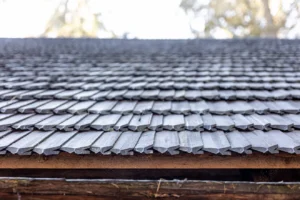
Wind Damage Roof Shingles and the Repair Decision
The decision between targeted shingle repair and a broader scope of work after a wind event resolves at the property level based on the findings of the professional assessment rather than from a general rule.
The relevant factors are the extent of mechanical failure across the full shingle field, the age and overall condition of the material, the installation quality revealed at the failure points, and whether the damage is concentrated in a way that reflects a localized vulnerability or distributed in a way that reveals systemic susceptibility.
Targeted repair is the appropriate scope when the missing and damaged shingles are limited in number and clearly identifiable, the surrounding field shows intact adhesive strips under hand pressure testing, the installation quality at the failure points is adequate for the roof’s age, and the material has meaningful remaining service life.
A handful of missing shingles on a seven-year-old Class 4 roof with solid adhesive elsewhere is a repair situation, and treating it as a replacement trigger based solely on the wind event overreacts to a contained failure.
The repair scope becomes more complex when the wind event has exposed installation deficiencies that affect a broader area of the roof.
Fasteners consistently located outside the nailing zone across the full damage section, inadequate fastener spacing that allowed systematic uplift rather than isolated failure, and a nailing pattern that drove fasteners through the nailing slot rather than centered in it are installation deficiencies that the wind event revealed but did not create.
Repairing the visible shingle damage while leaving those deficiencies in place is a repair that addresses the evidence of the problem rather than the problem itself.
Full or partial replacement becomes the appropriate recommendation when the wind event exposed that adhesive performance has degraded across a broad section of the roof, when the installation deficiencies are systemic rather than isolated, or when the total scope of mechanical failures represents a percentage of the roof area that makes targeted patching economically equivalent to a more comprehensive approach.
A Chinook that removes thirty shingles from a nineteen-year-old roof with widespread tab lifting detectable under hand pressure across adjacent sections has not created a repair situation in any meaningful sense. It has accelerated a replacement that the material was already approaching on its own timeline.
At Lumina Roofing & Exteriors, wind damage shingle assessments always include both the visible failure scope and the surrounding field condition, because the visible damage from a Chinook event is rarely the full picture of what the wind did to the adhesive and fastener system across the broader shingle field.
If you are trying to determine whether the shingle damage you are looking at after a Calgary wind event is a targeted repair or a signal of something more extensive, explore our storm damage services to see how we approach wind damage evaluations on Calgary residential roofs.
Preventing Wind Damage Roof Shingles on Future Calgary Events
Protection against wind damage roof shingles in Calgary’s Chinook corridor relies fundamentally on material choice and installation quality, determined during the initial installation or the latest replacement.
Class 4 impact-rated architectural shingles, made with modified asphalt, maintain better adhesive pliability in low temperatures, crucial for Calgary’s winter Chinook conditions. The adhesive strip’s bonding strength in cold weather is a key specification often overlooked by homeowners, significantly affecting shingle performance during diverse weather events.
Installation variables like fastener pattern and count are pivotal in distinguishing between roofs that withstand Chinook winds and those that do not. While the standard four-fastener installation suffices for minimum wind classifications, a six-fastener installation, recommended by major manufacturers for high-wind zones, offers substantially better resistance to the uplift caused by Chinook winds.
In Calgary’s southern communities, where exposure is greater, the marginal cost of the six-fastener installation proves worthwhile for enhanced wind resistance.
Annual inspections before Chinook season are crucial for identifying vulnerabilities in shingles, particularly in adhesive strips, ridge cap fasteners, and flashing seals. Addressing minor issues, such as re-securing a lifted tab, is significantly less costly than repairing damage from a missing shingle after a Chinook event.

Taking the Right Next Step After a Calgary Wind Event
Wind damage roof shingles in Calgary exist on a range from minor adhesive strip failures that need professional re-securing before the next Chinook to significant shingle loss that has created an immediate moisture intrusion risk.
Determining where your specific roof sits on that range requires an assessment by someone who has physically examined the failure points at close range rather than estimated the scope from the driveway.
If your Calgary home has been through a significant wind event and you want an honest evaluation of what the shingles actually sustained and what the appropriate response scope is, contact Lumina Roofing & Exteriors to schedule a professional wind damage assessment before the next weather event makes the decision for you.